
Medical Nutrition Therapy Rotation, End of Week 4
It’s hard to believe that a month has passed since returning to my hometown and beginning my final rotation. It feels surreal to be back in the same place I was five years ago, contemplating changing the trajectory of my life and deciding to go back to school. Talk about a full-circle moment. Now, instead of wondering whether I should take that leap, I’m looking toward what comes after graduation and where this journey will take me next. There are plenty of unknowns, but as I head into the second half of this rotation, I know the time is going to fly by.
One experience that has definitely pushed me outside of my comfort zone has been performing nutrition-focused physical exams (NFPEs) in a real clinical setting. Practicing on classmates in a classroom is one thing (while trying not to laugh through the awkwardness), but performing an NFPE with actual patients is entirely different. You quickly learn that it isn’t just about remembering the assessment steps, it’s about determining whether the timing is appropriate, considering the patient’s comfort, and recognizing when the exam should wait until a follow-up visit. Every patient presents unique considerations, whether that’s chest tubes, central lines, colostomies, surgical incisions, pain, or fatigue. Learning to adapt while still completing a thorough assessment has been both challenging and incredibly valuable.
The biggest challenge, however, has been translating everything we’ve learned in the classroom into real-world patient care. Textbooks often present disease states individually, but patients rarely come with just one diagnosis. Instead they arrive with multiple complex conditions that all influence one another. Imagine caring for someone with congestive heart failure, chronic kidney disease, and malnutrition. On one hand, chronic kidneys disease may make you cautious about protein intake. On the other, both heart failure and malnutrition increase protein and energy needs to support recovery. Suddenly there isn’t one “correct” answer from a textbook. Instead, you have to step back, prioritize what is most important for that patient in the moment, determine which nutrition interventions will provide the greatest benefit, and continually monitor how those interventions affect their overall clinical picture (CRDN 1.5).
Anther experience that reinforced this idea was participating in a taste test of ProSource mixed with different Greek yogurt bases. Our goal wasn’t simply to decide which one tasted better, it was to think about what patients would actually be willing to eat while also considering texture and swallowing safety. We compared plain (currently used) and vanilla Greek yogurt, discussing whether the vanilla introduced too much artificial flavoring while evaluating the overall consistency of each mixture. Our speech-language pathologist even joined the discussion, noting that the final product fell somewhere between a nectar-thick and thin-liquid consistency. The overall consensus was that the vanilla yogurt created a much more palatable option than what is currently being used. My first thought after tasting it? Wow…that’s a lot of flavor! It actually reminded me of a pink Starburst. Moments like this reinforced the idea that nutrition care extends far beyond calculating calorie and protein needs. The most nutritionally complete option doesn’t help if patients won’t. . . or can’t eat it.
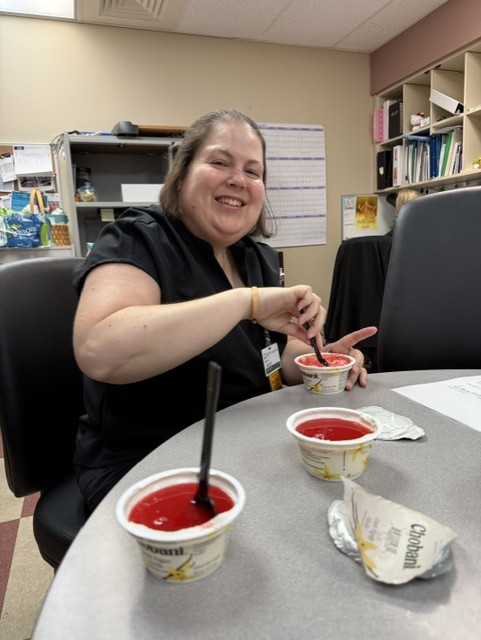
Evidence-based. . .with a side of taste testing. We compared different yogurt bases mixed with ProSource to evaluate consistency, flavor, and what patients might actually be willing to eat. My verdict? It taste just like a pink Starburst! 🍓
That constant balancing act has probably been the most mentally demanding part of clinical nutrition, but it’s also what makes it so rewarding. Every patient requires critically thinking, collaboration with the healthcare team, and individualized decision-making. Watching a patient begin to improve, tolerate nutrition better, regain strength , or simply feel a little better each day serves as a reminder that nutrition truly plays an important role in healing. Moments like this reinforce why all of the studying, care planning, and clinical reasoning matter.
Outside of the hospital, life has settled back into some familiar summer traditions. Tuesday nights have officially become cheap movie nights with my parents again, and we’ve already enjoyed The Devil Wears Prada 2 and The Breadwinner. They’ve both touched my sentimental millennial heart, and between the laughs and the buttery popcorn, they’ve made for some wonderful evenings.
This weekend we also made a quick trip to Nashville to see Hamilton at TPAC with my aunt and cousin. It absolutely lived up to the hype and was an incredible performance from start to finish!
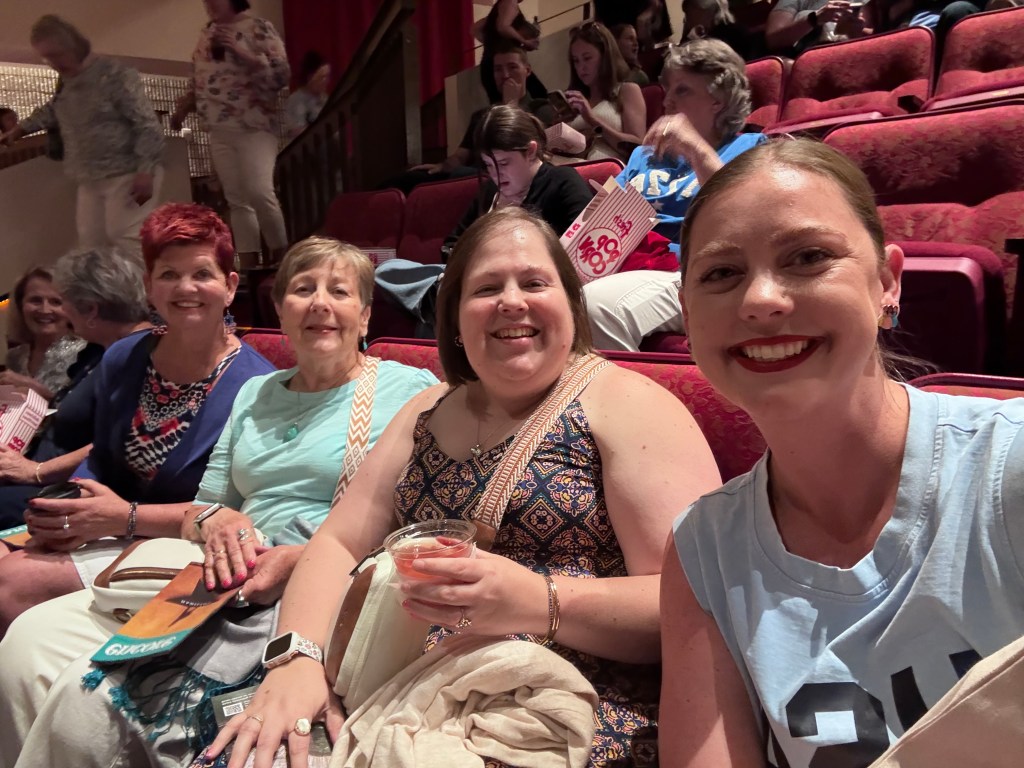
Not all learning happens in the hospital, sometimes it happens with family, great music, and an unforgettable performance of Hamilton at TPAC. 🎭🇺🇸
Finally, if you’re reading this sometime over the next week, please send a few happy thoughts our way. Our household had suddenly grown by four as my nieces and nephews, are staying with us while attending Vacation Bible School (VBS). As I write this, we’re only on day one, and I’ve already accepted that sleep may simply be optional this week. Wish my parents and me luck! I’ll catch you on the other side!
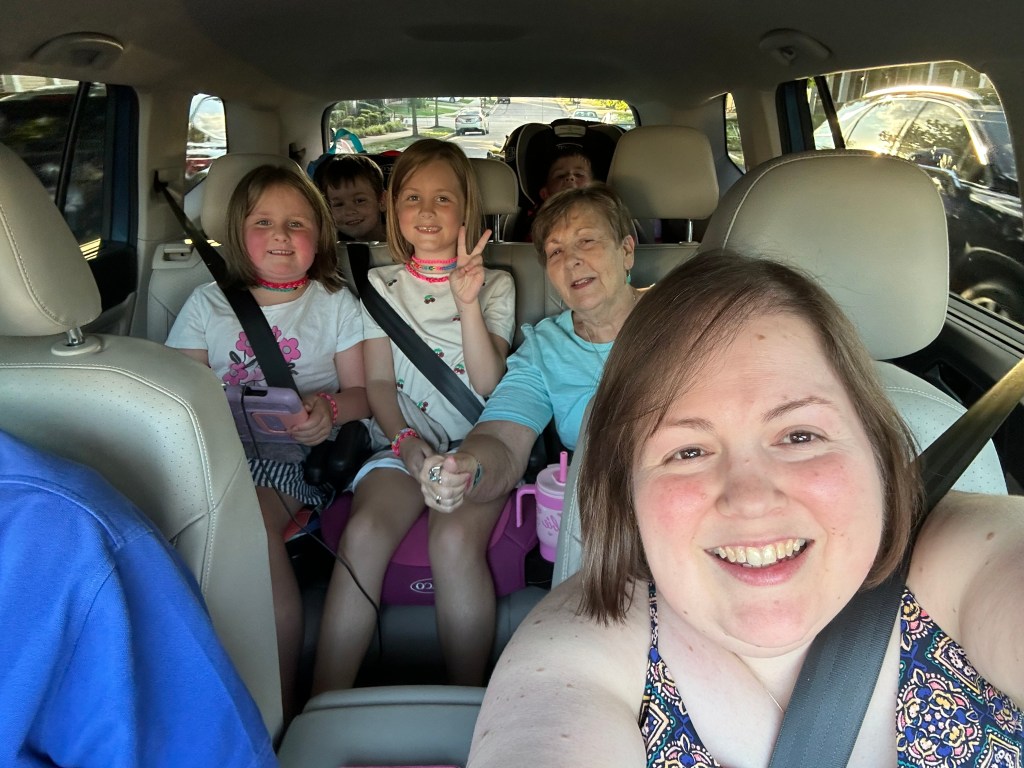
The calm before the chaos…..loading up the crew for a week of Vacation Bible School. Here’s hoping coffee and Diet Coke can carry us through the week! Wish us luck! 🤣☕️
“One step closer, one lesson learned, and always in progress.”


 Pancreas in Progress
Leave a comment